 FoxChild@Learn
16. Food — school option
Curriculum status: Optional school choice. Choose one of food, water or energy for detailed study.
This guide follows AQA GCSE Geography 8035. Named examples below are suggested teaching examples where the specification allows a school choice; use your teacher’s selected case study and verify current figures before an assessment.
Required knowledge
- Explain global food surplus/deficit patterns, rising demand and factors affecting supply.
- Assess impacts of food insecurity and strategies to increase supply.
- Evaluate sustainable food systems and a large-scale development plus a local LIC/NEE food scheme.
Key vocabulary
| Term | Meaning |
|---|---|
| food security | reliable physical and economic access to sufficient nutritious food |
| undernutrition | inadequate intake of energy or nutrients |
| agribusiness | large-scale commercial farming and related businesses |
| hydroponics | growing plants in nutrient solution without soil |
| permaculture | designing productive systems modelled on ecological relationships |
How the geography works
Food demand rises with population, incomes and changing diets. Supply is affected by climate, water, soils, technology, pests, conflict and poverty. Irrigation, biotechnology, hydroponics and large-scale schemes can raise output, but may use water, energy or land and can affect access. Sustainable approaches reduce losses and improve resilience as well as production.
1. Food security: more than producing enough
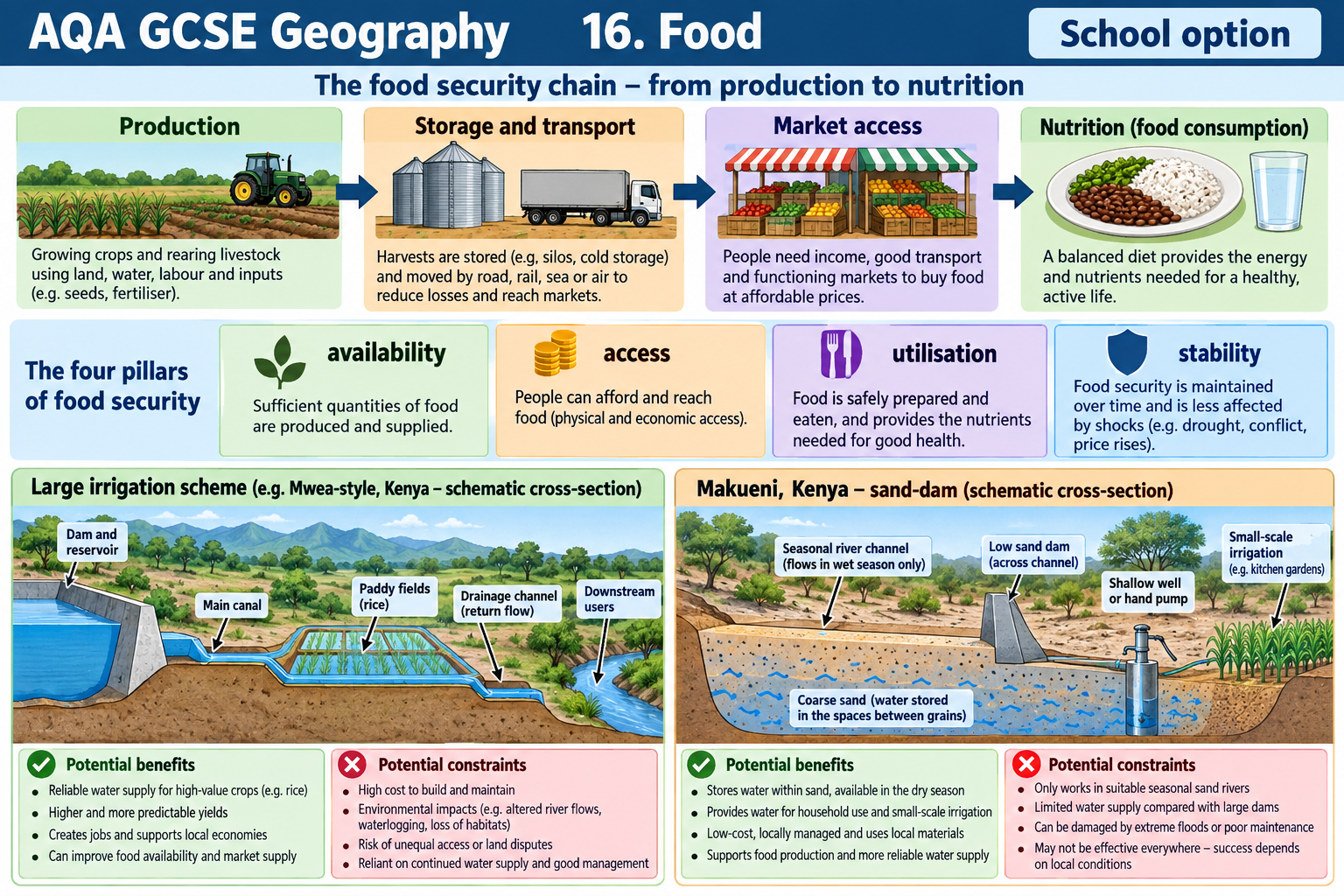
Food security exists when people can reliably obtain enough safe, nutritious food for an active and healthy life. The FAO framework describes four connected dimensions:
- Availability: enough food is physically present through production, imports, food stocks and movement through markets.
- Access: people can obtain food through income, own production, exchange, transfers, functioning markets and physical access to shops or distribution.
- Utilisation: food is safe and nutritious and the body can use it. Diet quality, clean water, sanitation, health and food preparation all matter.
- Stability: availability, access and utilisation remain reliable over time, rather than collapsing during a seasonal gap, price shock, conflict or hazard.
Food insecurity occurs when one or more of these dimensions is weak. A country can produce enough calories nationally but still have households without a nutritious diet because wages are low, markets are distant or prices are unaffordable. A family may have adequate food during harvest and face a shortage before the next harvest. A child may consume enough calories but lack varied nutrients. A temporary emergency and chronic undernutrition are different experiences, although they can overlap.
Food security is also linked to rights and agency. People need a meaningful role in decisions about land, seed, water, markets and food policy. A programme that raises production but removes farmers from their land may increase supply while damaging livelihoods. A farming system that depends on a single purchased seed and fertiliser supply may have a high yield in a favourable year but leave farmers exposed to price shocks. Ask who makes choices and who controls the harvest.
Availability, production and access are different measures
National food availability can be estimated from production, imports, exports, changes in stocks and losses. A simple accounting identity is:
Food available for domestic use = production + imports − exports − losses ± stock changes.
This is a supply measure, not a complete description of household food security. It does not show whether food reaches remote villages, whether a household can afford it, how nutritious the diet is or whether the supply will continue next month. Per-person calorie availability is also an average: it does not describe each age group, neighbourhood or household.
Food self-sufficiency and food security are related but not identical. Self-sufficiency describes how much of a country’s food it produces itself. Trade can make a country less self-sufficient but more secure if imports are affordable and suppliers are diverse. Domestic production can increase self-sufficiency yet still fail to make food affordable. A resilient food system often combines domestic capacity, varied trade, storage, local distribution, safety nets and reduced waste.
Food insecurity and nutrition vocabulary
| Term | Meaning and how to use it |
|---|---|
| food availability | The amount and type of food physically supplied to a place over a stated period. |
| food access | The ability to obtain food physically, socially and economically. |
| food utilisation | Safe preparation and consumption of nutritious food, including the body’s ability to use it. |
| food stability | The reliability of all other food-security dimensions over time. |
| undernutrition | Inadequate energy or nutrient intake relative to needs; identify the measure and age group. |
| malnutrition | Poor nutrition that may involve deficiencies, imbalances or excesses of energy or nutrients. |
| famine | An extreme food emergency with widespread severe deprivation and mortality; do not use for every food shortage. |
| food sovereignty | The principle that communities and peoples should shape their food systems and production choices. |
| food loss | Reduction in quantity or quality during production, handling, storage and distribution before retail or consumption. |
| food waste | Edible or potentially edible food discarded at retail, food service or household stages, depending on the definition. |
2. Global patterns of surplus and deficit
Food production is uneven across the world. Temperature, rainfall, soils, relief, growing seasons and water availability influence what can be cultivated and when. Major crop-producing regions tend to include fertile plains, river valleys, temperate grasslands and irrigated areas. Drylands and cold environments face shorter growing seasons or water constraints; tropical environments can grow a wide range of crops but may experience nutrient-poor soils, intense rain, pests and heat stress. Physical conditions matter, but technology, land ownership, infrastructure, trade and policy alter what is produced and who benefits.
Food-surplus and food-deficit areas are not fixed global blocks. A country may export cereals while some households are undernourished. A region may grow cash crops for export and import staple grains. Within the same year, a drought-affected rural area may face shortages while a nearby city has food in shops at prices that poorer households cannot afford. Some governments build national reserves; businesses and wealthier households may have access to storage that poorer people do not.
Maps of average calorie supply or food production can reveal broad patterns, such as higher production in major grain belts or low average food availability in a conflict-affected region. They cannot show diet quality, inequality, seasonal shortage or access without other evidence. A map may use a national total rather than a per-person measure, or classify values into broad categories. Check the date, indicator, boundary and legend before using it.
Rising global demand
Demand increases as population grows, but population is not the only driver. Rising incomes can change diets towards more meat, dairy, oils, fruit and processed foods. This shift may require additional grain for animal feed, more refrigeration and processing, and greater use of land, water and energy. Urbanisation changes how food is bought, stored and distributed; supermarkets and cold chains can create new markets but may displace local shops and farmers if bargaining power is uneven.
Food preferences, culture, age structure and household size also influence demand. Some households rely on staples and prepare food at home; others purchase prepared meals and eat a more diverse diet. A growing population can make total demand rise even if diets and per-person consumption do not change. Conversely, economic hardship can reduce access even where food production is increasing.
The changing demand for high-value food exports from low-income countries can create opportunities. Horticulture, flowers and fresh vegetables can earn export income and support jobs in growing, grading, packing, refrigeration and transport. These products may be harvested in seasons when northern consumers have less domestic supply. However, export crops can compete for land or water with food for local consumption, and workers may face demanding conditions. Assess whether wages, taxes and local supplier links are sufficient to spread benefits.
Measuring global food insecurity
Food agencies use more than one measure because hunger and food insecurity have different dimensions. Estimates of undernourishment assess whether habitual dietary energy supply is below a minimum requirement; experience-based scales measure whether people have faced constraints in accessing food; acute food-insecurity classifications assess severity in particular places and periods. These measures are not interchangeable. A national prevalence estimate cannot identify every affected household, while a crisis classification may cover only a defined population and season.
The UN food agencies’ 2026 report estimated that about 2.1 billion people experienced moderate or severe food insecurity during 2025, around 25.8% of the world population. It also reported that food insecurity and hunger remain uneven between regions and that food-price affordability is a major concern. Use this as a dated global context statistic, not a number that describes one country or one child. It is based on a defined methodology and may be revised as new survey evidence becomes available.
Regional differences reflect both population size and prevalence. A region with a high absolute number of people affected may have a lower percentage than a smaller region. Always state whether a map or graph shows a count, rate, percentage or severity classification. For a strong explanation, connect the pattern to climate, conflict, prices, household income, infrastructure or social protection using evidence specific to the place.
Diet quality and changing consumption
Calories describe energy content, not the full nutritional quality of a diet. A varied diet may include sources of protein, fats, carbohydrates, fibre, vitamins and minerals in suitable proportions. Safe water, sanitation and health affect whether nutrients are absorbed and whether illness raises nutritional needs. Food security therefore links agriculture to public health, gender, education and household care.
As incomes rise, consumption can shift towards more animal products, processed foods and out-of-season fruit. Livestock production can use large quantities of feed and land, but livestock systems differ: ruminants grazing on land unsuitable for crops are different from animals raised intensively on grain. Changes in diet can bring nutritional benefits where people lack protein or micronutrients, while high consumption of some processed products can increase health risks. The geography question is how food production and access change with income, not whether one national diet is universally correct.
Retail and marketing also shape choices. Supermarkets can offer stable supplies and quality standards, but small producers may struggle to meet volume, packaging and delivery requirements. Street markets and small shops may be more accessible in some communities and provide flexible work. Digital platforms can connect growers with consumers, but access to data and payment systems is uneven. Food environments influence availability, price and preference together.
Food systems connect distant places
A modern food system links farms, input suppliers, processors, storage, transport, wholesalers, retailers, food services and households. A single product can contain ingredients grown in several countries, be processed elsewhere and be sold through a company headquartered in another place. This gives consumers a wide range of food and can help businesses match supply to demand. It also creates dependencies on fertiliser, fuel, packaging, seeds, finance, ports and digital coordination.
Long supply chains can provide economies of scale and lower some costs per unit, but concentration around a few suppliers or routes can make disruption consequential. A blocked port, harvest failure, fuel price increase, disease outbreak or conflict can affect availability and prices far from the original event. Local sourcing, diverse imports and strategic reserves can each contribute to resilience; none is sufficient in isolation.
Reading a global production map
Large crop-producing belts are shaped by combinations of growing-season length, temperature, soil, rainfall, river water, irrigation, mechanisation and access to markets. Temperate grasslands and plains can support extensive cereal production; river valleys and deltas may support intensive cultivation where water and fertile sediment are available; tropical zones can grow multiple crops where heat and rainfall suit them. Yet a climate zone alone does not predict output. In the same climate, investment, land tenure, crop choice and transport can produce very different yields.
Production and consumption maps may also show different patterns. A region can grow an export crop and import staples; a city can consume food produced far away; livestock regions can depend on feed from other continents. Draw a flow arrow only where trade data support it, and distinguish the farm-gate location from the final market. A map of calorie supply per person does not measure household affordability, and a map of crop yield per hectare does not show how much land is cultivated.
When comparing surplus and deficit, specify whether the comparison refers to a local harvest, a national food balance or household experience. Surplus can be seasonal and difficult to store. Deficit can reflect low production, but it can also occur when food is priced beyond household means or blocked from a market. This difference is central to explaining why expanding production may help without resolving insecurity.
3. Factors affecting food supply
Climate and climate variability
Crops have temperature, rainfall and sunlight requirements. Too little rain can reduce germination, soil moisture and crop growth; too much rain can waterlog fields, wash away soil and delay harvests. Frost can damage buds and young plants. Heatwaves can stress crops and livestock, increase evaporation and reduce worker productivity. A shift in rainfall timing may be more damaging than a similar change in annual total if rain misses planting or flowering periods.
Farming calendars adapt to seasons, but variability makes decisions harder. Farmers may sow later, change varieties, irrigate or use forecasts. Climate projections can inform long-term choices, while seasonal forecasts help with immediate planning; uncertainty remains and farmers need access to reliable information. Climate change affects regions differently and can increase the frequency or severity of some risks, but the effect on a specific harvest also depends on land management, water, technology and exposure.
Technology, knowledge and inputs
Farm output can rise through better seed, soil management, irrigation, machinery, fertiliser, pest control, breeding, storage and knowledge. A combine harvester can save time on a large field but may not be affordable or suitable for a small farm. Drip irrigation applies water close to roots and can reduce some losses, but requires initial investment, maintenance and often a reliable water source. Mobile weather alerts or market-price information may help farmers plan, but only if users have connectivity and can act on the information.
Fertiliser can replace nutrients removed from soil by harvests; pesticides can reduce crop loss from pests. Misuse or excessive use can harm soil, water, pollinators and human health. Better agronomy aims to match inputs to crop need, improve soil structure, rotate crops and use integrated pest management. Knowledge is not a substitute for credit or land rights: farmers may understand a practice and still be unable to invest in it.
Pests and disease
Insects, fungi, bacteria, viruses and weeds can reduce yields or make food unsafe. A pest outbreak may spread rapidly when crops are genetically similar or large areas contain one variety. Warmer conditions can alter the range or life cycle of some pests. Livestock disease can reduce meat and milk, threaten livelihoods and lead to culling or movement restrictions.
Monitoring, resistant varieties, crop rotation, biological controls, sanitation, vaccination and quarantine can reduce risk. Chemical control may work quickly, but repeated use can select resistant pests and create risks to people and ecosystems. A single control method is vulnerable if it stops working, so integrated management combines approaches and adapts to local conditions.
Water stress, soil degradation and land
Water is needed for crops and livestock. Rain-fed farming depends on seasonal precipitation and soil moisture; irrigation can increase or stabilise production where water is available, but may overdraw rivers or aquifers. Water stress can intensify during drought, when agriculture competes with households, industry and ecosystems.
Soils can be degraded by erosion, compaction, nutrient depletion, salinisation, contamination or loss of organic matter. Steep slopes without cover are vulnerable to runoff; repeated intensive cultivation can reduce structure; over-irrigation in hot dry environments can leave salts behind as water evaporates. Soil conservation, cover crops, contour ploughing, agroforestry, organic matter and careful grazing can improve resilience, but recovery may take time.
Land ownership and competition influence production. Land may be used for food crops, export crops, livestock, urban growth, mining, energy infrastructure, conservation or tourism. Large-scale land acquisition can attract capital and raise production but may restrict access for small farmers or pastoralists. Secure tenure can encourage long-term soil improvements; uncertain access can make households reluctant to invest. The social geography of land is therefore part of food supply.
Conflict, poverty and infrastructure
Conflict can displace farmers, prevent planting and harvest, damage irrigation and storage, close roads and restrict markets. People may lose access to land or depend on emergency food assistance. The causes of conflict are complex; it is inaccurate to explain every food emergency as the direct result of conflict alone. Drought, displacement, poverty, prices and political decisions can interact.
Poverty affects food access even where shops are stocked. If food prices rise faster than wages, households may reduce meal size, switch to less nutritious foods or spend less on health and education. A remote community may face higher prices because food has to travel over poor roads. Electricity shortages can affect refrigeration; lack of storage can force farmers to sell quickly at low prices or lose crops after harvest.
Roads, ports, warehouses, cold chains, markets and communications determine how efficiently food moves. Infrastructure can reduce post-harvest losses and connect farmers with buyers, but it requires finance and maintenance. Infrastructure projects may also displace people, fragment habitats or benefit export corridors more than local food access. Ask which route is improved and who can use it.
A causal chain for supply and access
Use a sequence to explain rather than label a single cause:
Prolonged rainfall deficit → lower soil moisture → crop stress and lower yields → reduced market supply → higher staple prices → reduced household access for people with low incomes.
The same drought may have smaller effects where a community has groundwater, irrigation, savings, food storage, functioning roads, insurance and social support. Another chain might be: conflict damages a road → farmers cannot reach a market → perishable food spoils → local incomes fall and urban supply decreases. To evaluate, identify where a response could interrupt the chain.
4. Impacts of food insecurity
Health and nutrition
Insufficient energy intake can cause undernutrition, weight loss and reduced physical strength. Lack of particular nutrients can affect growth, immunity, pregnancy outcomes and cognitive development. Children may miss school or find it harder to concentrate; adults may be less able to work, creating a cycle in which poor health reduces income and low income limits nutritious food. Long-term effects may persist after food availability improves.
Malnutrition can also include excess energy intake and diets high in salt, sugar or unhealthy fats. Food insecurity therefore is not always visible as starvation: people may consume cheap calories while lacking a balanced diet. The double burden of malnutrition can occur within a country or household. Health evidence must state the population, age group, measurement and time period.
Famine and acute emergency
Famine is an extreme humanitarian crisis rather than a synonym for drought or hunger. Severe food deprivation can lead to acute malnutrition, disease and mortality. It may be associated with conflict, displacement, market collapse, drought, flood, animal disease, political restrictions or several factors together. Humanitarian agencies use specific thresholds and evidence to classify conditions; a student should not declare a famine based on a single photograph or one poor harvest.
Emergency response may include food aid, cash assistance, nutrition treatment, seed support, water and sanitation, protection and restored transport. Cash or vouchers can support choice when markets are functioning and supplied; direct food aid may be necessary when food cannot be purchased or delivered locally. The response should avoid harming local producers or creating unsafe access. Long-term recovery needs more than short-term distribution.
Soil erosion and environmental feedbacks
When households face food shortages, they may cultivate marginal land, shorten fallow periods, remove vegetation for fuel, overgraze pasture or farm steeper slopes. These choices may be necessary for immediate survival but can expose soil to erosion and reduce future productivity. This creates a feedback: food insecurity drives land pressure, which can make future food production less reliable.
The response should address the constraints that lead to unsustainable land use, such as lack of secure land, income, fuel, water, extension services or alternatives. Soil conservation techniques can help, but farmers need a reason and capacity to maintain them. A landscape project without local rights or livelihoods may fail even if its environmental design is technically sound.
Prices, markets and social stability
Food-price rises affect households differently. A family that spends a large share of its income on staples has fewer options to absorb a price shock than a wealthier household. Farmers who are net buyers of food can also lose when prices rise; being a farmer does not automatically mean having surplus food to sell. Retailers, processors and traders may pass on costs, but market power influences how quickly prices reach consumers.
Rapid price increases can trigger protests or political pressure, particularly when people believe supplies are unfairly distributed. Social unrest is not automatic: government responses, safety nets, trust, local networks and alternative supplies matter. Food insecurity can also increase migration as households seek work or move away from risk, but migration is one of several possible responses and should not be presented as inevitable.
5. Strategies to increase food supply
Increasing supply can reduce scarcity, but the strategy needs to fit local conditions and improve access. Yield per hectare, total production, crop diversity and reliable availability are different outcomes. A scheme may increase the national harvest but have a limited effect on household nutrition if food is exported, unaffordable or poorly distributed.
Irrigation
Irrigation moves water to crops when rainfall is insufficient or unreliable. Surface irrigation uses channels or basins; sprinkler systems distribute water overhead; drip irrigation sends water through pipes and emitters close to plant roots. Irrigation can allow more than one crop per year, reduce the risk of a failed rainy season and support higher-value crops. It can also make production more predictable for markets and processing.
The system requires a dependable source, energy or gravity flow, canals or pipes, technical knowledge and a way to allocate water. Inefficient irrigation can lose water through evaporation, leakage or seepage. Over-abstraction may reduce downstream flows and groundwater; poorly drained land may become waterlogged or saline. A large dam or canal can alter ecosystems, sediment movement and land use. Irrigation therefore increases supply only when water is managed within catchment limits and farmers can access the system fairly.
Hydroponics and aeroponics
Hydroponics grows plants without soil, using water containing nutrients. Roots may be supported by an inert medium or suspended in a solution. Aeroponics suspends plant roots and delivers nutrients through a mist or spray. These controlled systems can produce leafy vegetables in a small footprint, reduce some soil-borne disease risks and use water efficiently if recirculation and leakage are managed.
The system still needs water, nutrients, energy, technical knowledge and equipment. Artificial lighting or climate control can raise energy demand; pumps can fail; plastic and nutrient solutions need responsible management. High capital costs can restrict access to well-financed businesses. Hydroponics can be useful near urban consumers or where land is scarce, but it is not a straightforward replacement for field crops, staple grains, pastoralism or ecosystems.
The Green Revolution and agricultural innovation
The Green Revolution refers to a set of changes including high-yielding crop varieties, irrigation, fertilisers, pesticides, machinery and expanded agricultural research. In some regions these changes raised yields of crops such as wheat and rice and helped food production grow. Improved varieties can respond well to water and nutrients, and research can develop crops better suited to particular soils or climates.
Benefits were not distributed uniformly. Farmers who could afford seed, fertiliser, pumps and machinery were often better placed to adopt the package. The cost of inputs could place smaller farmers in debt or increase their exposure if rains failed. Irrigation can draw down water stores; fertiliser runoff can pollute rivers; monocultures can reduce genetic diversity; mechanisation can reduce some labour demand. Yield gain should therefore be judged alongside affordability, rural employment, water, soil and resilience.
New Green Revolution approaches often emphasise climate-resilient agriculture, improved extension, water management, soil health, digital services, research and wider access for smallholders. The “new” label does not guarantee sustainability. Examine which practices changed, who adopted them and what effects were measured.
Biotechnology
Biotechnology applies biological knowledge and techniques in crop or livestock production. Conventional plant breeding selects desired traits across generations. Modern biotechnology may use molecular methods to identify or alter particular traits. Potential aims include resistance to pests or disease, tolerance of drought or salinity, longer storage life or improved nutrition. The effect depends on the crop, trait, local ecology and how the seed is distributed and regulated.
Potential benefits include fewer crop losses, less need for some pesticides, improved resilience and more stable yields. Risks and debates include seed costs and patents, dependence on a small number of suppliers, cross-pollination concerns, effects on non-target organisms, public acceptance and the possibility that pests develop resistance. Biotechnology does not solve lack of land, income, infrastructure or fair access. AQA answers should show balanced evaluation and avoid assuming that all genetically modified crops have identical effects.
Appropriate technology
Appropriate technology is designed to fit local resources, skills, repair capacity, costs and needs. Examples include simple rainwater harvesting, hand tools, low-cost drip kits, improved grain stores, solar dryers, treadle pumps or community seed banks. A technology may be less productive per worker than a large machine but more accessible to small farms and easier to maintain locally.
Appropriate does not mean basic or universally suitable. A hand pump is of little use without a safe water source; a solar dryer needs sunlight, maintenance and protection from pests; a grain store needs monitoring to prevent moisture or insect damage. Communities should help choose and adapt the system. Repair training and spare parts matter as much as the initial equipment.
Better storage, transport and reduction of losses
Food supply can increase at the point of consumption if more of what is produced survives storage and transport. Drying, sealed containers, pest control, cold storage, reliable electricity, better roads and timely market information can reduce losses. Improved packaging can protect produce, but single-use packaging creates waste if recycling is unavailable. Cold chains use energy and refrigerants, so their climate impact should be managed.
Reducing waste also improves effective supply without expanding farmland. Losses can occur during harvest, storage, processing, transport, retail and consumption. The causes differ: farmers may lack suitable tools; roads may be poor; retailers may reject produce for appearance; households may buy more than they use. A good intervention matches the stage and incentive—for example, storage and processing for seasonal gluts, clearer date labels for consumers, or market channels for visually imperfect produce.
6. Large-scale agricultural development example: Mwea, Kenya
Teaching example: AQA requires a large-scale agricultural development that can be assessed for advantages and disadvantages. Mwea Irrigation Scheme in Kenya is a possible example; use your school’s chosen scheme if it differs.
Location and purpose
Mwea is in Kirinyaga County in central Kenya, in the upper Tana basin region southeast of Mount Kenya. The irrigation scheme supports rice production in an area where managed water helps farmers produce more consistently than relying only on seasonal rain. Rice is a major staple and market crop. The National Irrigation Authority describes the Mwea Irrigation Development Project as aiming to increase rice production through more rational water use, construction of Thiba Dam, rehabilitation of irrigation and drainage facilities, and improved scheme operations and management. The stated aims include expanding irrigated area, improving farmers’ livelihoods and contributing to food self-sufficiency.
How the scheme works
The scheme uses a linked system of water storage, intake, canals, field channels, drainage, farm plots and operational rules. A storage structure can regulate availability between rainfall events; channels distribute water to fields; drainage returns or redirects water after use. Rice cultivation depends on suitable growing conditions, land preparation, planting, water management, labour, seed, pest control, harvesting, milling and market access. The scheme is therefore a whole production system, not just a dam.
Potential advantages
- More reliable crop water: managed supply can reduce exposure to a poorly timed dry spell and help stabilise rice output.
- Greater production: irrigated land may support higher yields or multiple cropping where water, soil and management allow.
- Household and market income: farmers can sell a crop and spend earnings on goods and services; demand may support millers, traders and transport businesses.
- Food availability: increased domestic rice output can contribute to national supply and reduce some import dependence.
- Infrastructure and skills: canals, drainage, storage and scheme management can strengthen agricultural capacity, while training can improve water use and farm practice.
- Public benefit: the project’s purpose includes food self-sufficiency and farmer livelihoods, outcomes that can support wider economic goals if access is broad.
These are expected benefits and plausible mechanisms, not proof that every farmer or household receives the same result. Scheme-level output can increase while access to water, land or markets remains uneven. A case-study answer is stronger when it states which benefit is documented by the source and which one is an inference.
Costs, risks and questions to evaluate
Large irrigation infrastructure requires capital, engineering, land and ongoing maintenance. If water allocation favours head-end farms, downstream users may receive less. A dam or diversion can change river flow and affect other users or ecosystems. Construction can disturb land and livelihoods. Irrigated rice can require substantial water and labour; disease and pests may increase in particular conditions; fertiliser and pesticides can affect water quality if poorly managed. These are risks to investigate for the named project, not claims that every impact occurred at Mwea.
Reliability also depends on how the scheme responds to drought, flood, sediment, damaged channels and competing needs in the basin. Water efficiency on one field does not always reduce total use if farmers use the savings to expand irrigated area; monitor the basin as well as plot-level efficiency. A scheme may improve national production but offer little benefit to landless households unless they have access to employment, services or affordable food.
Evidence-based judgement
Mwea can help explain how large-scale agricultural development increases and stabilises food production by combining storage, water delivery, drainage and management. The central trade-off is between higher and more reliable harvests and the financial, social and environmental demands of infrastructure and water use. Judge the scheme by measured crop output and farmer livelihoods, the reliability and fairness of water distribution, maintenance, downstream effects, and how production changes household access to food. Do not equate “large scale” with either automatic success or automatic harm.
7. Moving towards a sustainable food future
Sustainable food systems meet present nutritional needs while protecting the capacity of ecosystems, communities and future generations to produce and access food. Sustainability has environmental, economic and social dimensions. A farming method might protect soil but provide too little income; a high-yield system may keep prices down but pollute water; an export scheme may earn income while reducing local access to land. Evaluate more than one dimension.
Organic farming
Organic systems use standards governing production, inputs, animal welfare and certification. They commonly restrict specified synthetic pesticides and fertilisers and may emphasise crop rotations, soil health and biological controls. Potential benefits include reduced exposure to some synthetic chemicals, support for soil organisms and biodiversity, and price premiums for producers who can access certified markets.
The outcomes depend on crop and place. Organic yields may be lower for some crops or in some conditions, so more land could be needed to produce the same amount. A lower yield is not inevitable in every farm or period. Organic production can still use machinery, refrigeration, packaging and transport; certification and transition may involve cost and risk. The label says which rules are followed, not that every environmental or social outcome is better.
Permaculture and agroecology
Permaculture designs productive land-use systems by observing relationships among plants, animals, soils, water and people. Practices can include polycultures, agroforestry, composting, rainwater harvesting, perennial crops, mulching and integrated pest control. Agroecology similarly applies ecological ideas to farming and food systems, often with attention to farmer knowledge and social relationships.
Diversity can spread risk: if one crop fails, another may still produce. Trees can provide shade, fodder, fruit, habitat and soil protection. Compost returns organic matter to fields. These systems can use local knowledge and lower reliance on some purchased inputs. They may require labour, land access, training and time to establish, and returns can be uncertain during transition. Their success should be measured in yields, income, nutrition, soil and resilience, not assumed from the name.
Urban farming
Urban agriculture includes allotments, community gardens, rooftop growing, market gardens, hydroponics and food produced around cities. It can shorten some supply chains, provide fresh produce, reuse urban spaces and create opportunities for education or community activity. Food grown close to consumers may need less transport and can be harvested near the point of sale.
Urban growing has limits: available land is scarce and may be contaminated; growing space can compete with housing or green space; production may be small relative to city demand. Rooftop or indoor systems require structural capacity, water, energy and technical management. Urban farming is a contribution to a city’s food system, not a substitute for rural agriculture and trade.
Sustainable fish and meat
Fish can be supplied through wild capture or aquaculture. Well-managed fisheries use monitoring, catch limits, gear and protected areas to allow stocks to recover; enforcement is essential. Overfishing, bycatch, habitat damage and illegal fishing can undermine future supply. Aquaculture can produce fish efficiently and reduce pressure on some wild stocks, but outcomes depend on feed, water quality, disease, escapes and the location of farms. A “sustainable” label needs a named standard or evidence.
Meat production varies from extensive grazing to intensive systems. Livestock can use grassland unsuitable for crops and provide food or income, but it requires land, water, feed and energy; some production generates methane and waste. Feed crops may compete with food grown for direct human consumption, although livestock can also use residues and pasture. Reducing waste, improving animal health, adjusting diets and matching production to local conditions can reduce pressure. Avoid saying all meat has one identical footprint.
Seasonal food and sourcing choices
Eating food in its natural local season can reduce the need for heated greenhouses, long storage or air freight for some products. Seasonal menus can strengthen links with local producers and encourage varied diets. However, consumers may still need imports for products that do not grow in the local climate, and some imported crops are produced efficiently in warmer conditions. Compare the full production and transport system rather than distance alone.
Local sourcing can support farmers and improve traceability, but only if local businesses can supply the product, meet standards and deliver at a workable price. Public procurement by schools, hospitals or councils can provide a stable market for local producers. Direct markets can keep a larger share of the sale price with the grower, although the farmer still faces transport, time and marketing costs. A fair comparison includes access for low-income households.
Reducing food loss and waste
Food loss and waste occur at different stages and need different solutions. Harvest losses may fall with suitable tools and training; storage losses may fall with dry, pest-proof facilities; processing losses may be reduced by using surplus produce; supermarket waste may be affected by stock management and product standards; household waste may fall through planning, storage and clearer understanding of date labels.
Reducing waste can improve the effective food supply and reduce land, water, energy and labour used for food that is never eaten. It can also save money for households and firms. Some unavoidable waste can be composted or used in anaerobic digestion, but recovery is usually preferable to prevention because it retains more of the resources and labour invested in growing food. Food donation must be handled safely and should not replace decent wages or social protection.
8. Local sustainable food example: Makueni, Kenya
Teaching example: Makueni County in south-eastern Kenya is one possible local example linking water harvesting and food supply in a lower-income setting. Specific school case-study material may use a named programme or village; use the example your teacher expects.
The challenge and local setting
Makueni lies in Kenya’s semi-arid south-east, where rainfall is variable and seasonal rivers may flow strongly after rain and then become dry. Water access affects household needs, livestock, food growing and the time people have for school or paid work. Unreliable water can make rain-fed farming more vulnerable and make it harder to grow vegetables during dry periods. The challenge is not simply an absence of rain: it is the timing of rain, limited storage, groundwater access, soil and the distance between water and users.
How sand dams can support food supply
A sand dam is built across a seasonal sandy river channel. During rainy periods, water moving along the channel slows behind the structure and sediment accumulates. Coarse sand stores water within the riverbed, where evaporation can be lower than from an open surface reservoir. Wells, shallow wells or pumps can then make stored water accessible, depending on the site design. Sand dams should be placed where river channels, sediment and catchment conditions are suitable; the structure does not create new water and cannot guarantee supply if rainfall remains very low.
More reliable water may support kitchen gardens, small-scale irrigation, livestock and tree establishment. Growing vegetables can diversify diets and provide surplus produce for sale. If households spend less time travelling to fetch water, time may be freed for education, care or income-generating work. Community participation in construction and management can build local skills and collective stewardship.
The Makueni County government reports partnerships with the Africa Sand Dam Foundation to construct sand dams and describes conservation, riverbed restoration, water retention and riparian agribusiness as intended or reported benefits. Its 2025 account of a climate-smart irrigation initiative in Kithungo/Kitundu describes a scheme using water captured in sand and underground storage to support year-round crop growing; the same announcement describes a further storage tank as a future plan. Separate county reporting in 2026 gives a much larger cumulative sand-dam total across county and partner projects. These are government-reported project figures; keep dates and project boundaries clear rather than combining unlike counts.
Why this can be sustainable
The system uses seasonal river flow and local materials, and can be community-managed. Storing water in sand can reduce direct exposure to evaporation compared with an open pond. Small-scale access may be more attainable than a region-wide transfer or major dam. Connecting water storage to conservation agriculture, drought-tolerant crops, soil management and local markets can support longer-term production rather than one emergency harvest.
Limits and evaluation
Sand dams are site-specific. They require a suitable seasonal channel, stable foundations, suitable sand and a catchment that supplies enough water. A poorly located or poorly built barrier may fail, silt up or provide less storage than expected. Construction requires labour, materials, expertise and agreement about where and how the structure will be used. Maintenance and fair water rules are essential, particularly during a long drought.
More water can enable irrigation but can also raise abstraction and create conflict if upstream and downstream users are not represented. If high-income households or large farms control pumps and water access, the benefits may not reach poorer residents. Increased cultivation can also add pressure to soils and vegetation unless soil and land management improve. The project’s effect on household nutrition depends on what is grown, who consumes or sells the crop, household income and food prices.
Evidence for success should include more than the number of dams built. Useful measures include the reliability and quality of water, distance or time needed to collect it, area irrigated, crop diversity and yield, household income, nutrition, maintenance records, groundwater or river conditions, and who uses the system. A project can be sustainable in a particular community without solving food insecurity across the whole county or country.
Makueni case-study chain
Variable rainfall and dry seasonal rivers → sand dam captures flowing water and stores it between sand grains → wells or pumps provide a more reliable local source → household or smallholder irrigation supports additional crops → improved diet or market sales can strengthen food access.
Then evaluate: this chain depends on a suitable site, adequate recharge, fair access, safe water, maintenance and crop-market links. If a dry period is unusually long or a pump fails, benefits can decline. Community management and public support help, but should be evidenced for the particular scheme rather than assumed.
9. Compare a large-scale and a local scheme
| Question | Mwea Irrigation Development Project | Makueni community water/food initiatives |
|---|---|---|
| Main scale | Large irrigation scheme and major water infrastructure | Local structures and community or county-supported systems |
| Main purpose | Increase rice output through rational water use, dam/canal works and management | Improve water access, support small-scale irrigation and strengthen local resilience |
| Potential benefit | More predictable production, farmer livelihoods and national food supply | Nearby water, crop diversity, household production and reduced time spent collecting water |
| Main dependency | Basin water, infrastructure operation, fair allocation, maintenance and market access | Suitable riverbed and recharge, local agreements, maintenance and equitable access |
| Main risk to assess | Capital cost, altered flows, uneven distribution and environmental effects | Limited scale, drought sensitivity, site suitability and unequal control of pumps or land |
The large scheme may influence national production more directly; a local scheme may respond more closely to a community’s water needs. Scale alone does not determine sustainability. Compare reliability, access, maintenance, local participation, environmental impact and the evidence available for outcomes.
10. Food-supply evaluation and exam practice
Match the strategy to the constraint
| Constraint | Possible response | Evaluation point |
|---|---|---|
| Unreliable rainfall | Irrigation, water harvesting, drought-tolerant varieties, forecasts | Is water available through a severe drought, and who receives it? |
| Low yields or crop disease | Research, seed access, extension, integrated pest management | Can farmers afford and maintain the approach? What are ecological risks? |
| Post-harvest loss | Storage, drying, cold chain, transport and market information | Does the solution use affordable energy and reach small farms? |
| Low household access | Income support, jobs, cash transfers, safe markets and distribution | Is food physically present but unaffordable? Does support reach excluded groups? |
| Soil degradation | Cover crops, rotations, agroforestry, contour methods and organic matter | How long does recovery take, and can farmers maintain production during transition? |
| Price or route shock | Diverse trade, stocks, local capacity and regional cooperation | Does diversification raise costs or transfer risk to another supplier? |
Do not answer every food-security question with “grow more food.” If the problem is low income, a production scheme may not solve access. If food spoils after harvest, a new seed may not address the bottleneck. If a conflict blocks distribution, additional harvest in another region may not reach affected people. First identify the limiting factor, then select a measure that addresses it.
A balanced extended response
For a question assessing a strategy, a high-quality structure is:
- Identify the strategy and the food-security dimension it targets.
- Explain the causal mechanism from action to production or access.
- Use a named place and precise evidence, with a date where the figure can change.
- Analyse economic, social and environmental consequences for different groups.
- Weigh limitations and compare with another feasible approach.
- Reach a conditional judgement about where, for whom and over what period it is effective.
For example: a local sand dam can improve water availability for crop production in a semi-arid community, but only if a suitable channel recharges, users can access the stored water and the structure is maintained. It may increase food access for participating households without changing national food supply. This scale judgement is more useful than calling the scheme “successful” without evidence.
Common misconceptions
- A food surplus means everybody is food secure. Household income, distribution, diet quality and stability still matter.
- A famine is simply a drought. Famine is an extreme crisis and may have political, conflict, market and access causes.
- Irrigation always conserves water. Efficiency can reduce water per field, but total basin use may rise if irrigated land expands.
- High-yield seeds solve food insecurity. They may raise production but do not automatically improve land rights, affordability or nutrition.
- Hydroponics can replace field agriculture. It is suited to some crops and settings, not every staple, animal product or livelihood.
- Local food is always environmentally preferable. Production, season, storage and transport mode all contribute to impact.
- A sustainable scheme needs no outside support. Training, finance, governance and maintenance may be essential for local ownership.
Self-check
- Explain the four dimensions of food security using one example.
- Why can food insecurity occur when a country produces enough calories overall?
- Explain two ways rising income can change food demand.
- How can poor storage affect both farmer income and urban food prices?
- Give two possible benefits and two risks of irrigation.
- What is the difference between hydroponics and aeroponics?
- How could biotechnology improve production, and why might access remain unequal?
- Describe how Mwea’s irrigation infrastructure is intended to affect rice production.
- Explain the Makueni sand-dam chain from water storage to food access.
- Which measures would help determine whether a food-security project is sustainable?
Revision points
Food security is about reliable access to safe, nutritious food, not simply national production. Know the four dimensions, causes of rising demand, physical and human factors affecting supply, and the linked consequences of food insecurity. Learn one large-scale project and one local sustainable scheme in detail. For every strategy, trace the causal chain and evaluate who benefits, who pays, environmental effects, resilience and evidence of long-term outcomes.
Place example
A large-scale irrigation or agricultural project can illustrate both benefits and costs; a local community scheme in an LIC/NEE can illustrate sustainable supply. Select named examples taught by your school and check who controls land, water and produce.
Maps, data and evidence
Interpret calorie-intake or food-production maps with scale and year. Distinguish food availability from affordability, nutrition and stability; national average supply can hide household insecurity.
Common misconception
Food insecurity is not always caused by insufficient global production. Increasing yields alone may not solve unequal access or environmental limits.
Self-check
- Name three factors affecting food supply.
- How could irrigation increase production and create a cost?
- What makes a food scheme sustainable over time?
Revision points
This is one of three resource options; schools study one. Explain both supply and access, and evaluate a strategy through social, economic and environmental effects.
Curriculum alignment
- Curriculum coverage IDs:
aqa.3.2.3.food - Related practice packs:
gcse_geo_p2_human_environment_june_2022,gcse_geo_p2_human_environment_june_2023,gcse_geo_p2_human_environment_june_2024,gcse_geo_p2_human_environment_november_2020,gcse_geo_p2_human_environment_november_2021 - Shared concept tags:
food-security,agriculture,sustainability,resource-management
Sources
- Curriculum/specification: https://www.aqa.org.uk/subjects/geography/gcse/geography-8035/specification/subject-content/challenges-in-the-human-environment
- Food-security definition: FAO: Four pillars and sustainable food security.
- Global context: FAO: Global hunger statistics and trends; FAO: SOFI 2026 report. Figures cited are for 2025 and should be refreshed before reuse.
- Large-scale scheme: Kenya National Irrigation Authority: Mwea Irrigation Development Project.
- Local scheme: Makueni County: sand dams and food security; Makueni County: Kithungo/Kitundu climate-smart farming initiative; Makueni County Sand Conservation and Utilization Authority.
- Further reading: FAO: World food situation.
- For case-study facts, use the source list and figures selected by your teacher; dates, totals and local conditions can change between datasets.