 FoxChild@Learn
18. Energy — school option
Curriculum status: Optional school choice. Choose one of food, water or energy for detailed study.
This guide follows AQA GCSE Geography 8035. Named examples below are suggested teaching examples where the specification allows a school choice; use your teacher’s selected case study and verify current figures before an assessment.
Required knowledge
- Explain global energy supply/consumption patterns and reasons for rising demand.
- Explain physical, economic, technological and political factors affecting supply and insecurity.
- Evaluate strategies to increase supply and create a sustainable energy future.
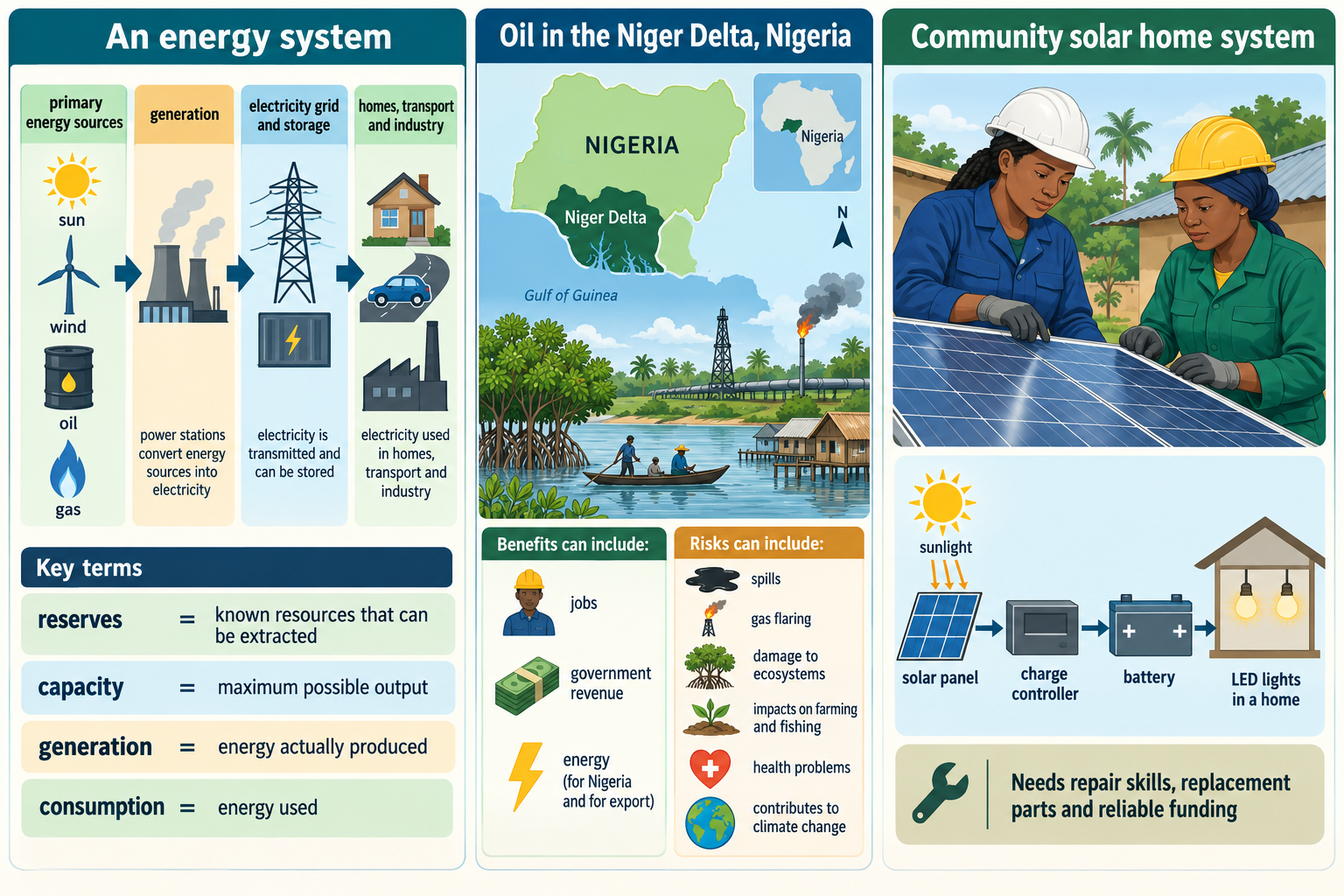
Key vocabulary
| Term | Meaning |
|---|---|
| energy security | reliable and affordable energy access |
| renewable | replenished naturally on a human timescale |
| intermittency | variable output depending on conditions |
| energy mix | shares of supply by source |
| carbon intensity | emissions per unit of energy/output |
How the geography works
Demand rises with population, development, technology and consumption. Fossil fuels are dispatchable but emit greenhouse gases and are finite; renewables reduce operational emissions but depend on location, storage, grid and material supply. Efficiency, diverse sources, interconnection and demand management can improve security.
1. Energy security and energy systems
Energy security is the reliable availability of energy at an affordable cost, with enough resilience to withstand disruption and with manageable environmental and social impacts. A secure system can deliver the right form of energy, in the right place, at the right time. It is not identical to energy independence: a country can import energy securely if its suppliers and routes are reliable, while a country with domestic fuels can still face outages if generation or networks fail.
Energy is required for heating, cooking, lighting, transport, communications, water treatment, farming, manufacturing, health care and education. It supports economic activity and quality of life, but its production and use can also create air pollution, greenhouse-gas emissions, waste, landscape change and competition for land or water. A source’s value depends on its role in a whole system from extraction or generation to storage, transmission, distribution and end use.
Primary energy, electricity and final energy
Primary energy is energy in a natural source before conversion, such as coal, crude oil, natural gas, uranium, wind, sunlight or flowing water. Electricity generation converts energy into electrical power. Final energy consumption is the energy delivered to the consumer as electricity, gas, petrol, district heat or another carrier. These categories have different denominators.
A chart of electricity generation can show the shares from wind, gas, nuclear and solar, but it does not show all energy used in road transport or home heating. A chart of primary energy can include fuels before conversion and may use different accounting rules for wind or nuclear. Installed capacity, measured in megawatts, is the maximum rate a plant could produce under specified conditions; actual generation over a period, measured in kilowatt-hours or terawatt-hours, depends on availability, weather, maintenance and demand. Never compare capacity directly with generation as if they were the same.
Energy-security dimensions
- Availability: Is there enough energy or generating capacity?
- Accessibility: Can users and networks physically obtain and distribute it?
- Affordability: Can households, firms and public services pay for it?
- Reliability: Is energy delivered when needed, with limited outage risk?
- Resilience: Can the system respond to supply shocks, cyber or equipment failures and extreme weather?
- Acceptability and sustainability: Are health, climate, land, water and community impacts within acceptable limits over time?
Energy poverty can occur in a country with a large national energy supply. A household may be connected to a grid but unable to afford adequate heating; a remote village may rely on expensive diesel; an urban settlement may receive intermittent electricity. A national consumption average hides these differences. Evaluate access and affordability as well as total production.
How electricity reaches users
An electricity system links generators to high-voltage transmission lines, substations, distribution networks and users. Generation needs to match demand over short time intervals because electricity is difficult to store at very large scale, although batteries, pumped storage, hydrogen, interconnectors and other technologies provide flexibility. Networks can fail because of storms, heat, equipment faults or overload. A power station’s fuel supply may also be disrupted.
Dispatchable generation can be increased or scheduled when needed, within its technical limits. Many gas or hydro plants can respond relatively quickly; nuclear and coal plants often operate steadily but are less flexible; wind and solar output varies with weather and daylight. Demand response shifts or reduces electricity use when supply is tight. Energy security therefore depends on a diverse portfolio, grid capacity, storage, flexible demand and maintenance rather than one source alone.
Daily demand, peak load and flexibility
Electricity demand changes through the day and across seasons. Morning and evening routines can create peaks; cold winters may increase heating demand and hot summers may increase cooling. Industry, transport, lighting and digital services add different patterns. A system needs enough generation and network capacity for periods of high demand, even if those assets are not used at full output every hour.
Peak load is the highest demand in a defined period. Base demand is the level that remains comparatively steady. Batteries can respond quickly for short periods; pumped hydro stores energy by pumping water uphill when electricity is available and releasing it through turbines later; interconnectors can share supply across regions. Demand response can shift flexible activities, such as charging a vehicle, to times of higher supply.
Variable renewable generation does not mean an electricity system is unreliable by definition. Forecasting, geographic diversity, storage, flexible generators, grid connections and demand management can balance variation. The amount and cost of balancing depend on the mix, geography, transmission capacity and weather patterns across connected regions. A system evaluation needs time-based evidence rather than annual totals alone.
Electricity access and productive use
Reliable energy can improve services and income when it is used productively. A clinic can refrigerate vaccines, a school can run lights and computers, and a small business can extend operating hours. Irrigation pumps and food processing can raise output, but may increase water or electricity demand. Access to a connection is an important foundation; appliances, finance, skills, service reliability and affordable tariffs determine how much benefit follows.
Distributed renewable systems can supply households and small businesses before a grid reaches them. Mini-grids may serve a group of homes, clinics, schools and shops, with local generation and storage. The system must forecast future demand, decide how to allocate power and plan for the replacement of batteries or inverters. If a grid later arrives, standards and planning determine whether the mini-grid connects, continues independently or becomes redundant.
2. Global patterns of energy supply and consumption
Fossil fuels are geographically concentrated. Large oil and gas reserves occur in several regions, including the Middle East, Russia, North America, parts of Africa and South America. Coal is found in multiple continents but the quality, depth and cost of extraction vary. Uranium, geothermal resources, hydropower potential, strong winds and high solar exposure also have uneven distributions. A resource map shows where a source exists; it does not show the cost or environmental feasibility of using it.
Renewable potential depends on physical conditions and infrastructure. Solar resources are strongest where sunlight is intense and relatively reliable; wind generation depends on wind speed, consistency, land or sea space and grid access; hydroelectricity depends on river flow and relief; geothermal resources are concentrated in areas with accessible heat; tidal and wave energy require appropriate coastlines and technology. Local geography, planning, finance and demand shape which sources are developed.
Energy supply and consumption are not located in the same places. Some countries export fuels while importing electricity or refined products. Major cities consume energy produced in distant regions. Electricity may travel through interconnectors between countries, while oil and gas move through pipelines, tankers and terminals. These networks support trade and diversify sources, but can expose users to route closures, price changes or diplomatic tensions.
Consumption per person tends to be higher in places with energy-intensive industry, higher incomes, larger homes, extensive transport and greater use of appliances, heating or cooling. It can also reflect climate and energy efficiency. A low per-person figure does not necessarily indicate efficient use: it may mean limited access. A high figure does not directly reveal whether energy is used productively or equitably. Compare total demand and per-person use carefully.
Why demand rises
Population growth increases the number of households, schools, hospitals, vehicles and workplaces that need energy. The effect depends on access and per-person consumption. A fast-growing population with limited electricity access can have a low current average but a strong future demand for basic services.
Economic development can expand manufacturing, construction, transport, refrigeration, communications and household appliance ownership. Industrialisation may increase demand for electricity and fuels; service economies also use energy in offices, data networks, retail, health care and tourism. Higher income can raise demand for private transport, larger homes and cooling, though efficient buildings and public transport can alter the relationship.
Technology can increase or reduce demand. Data centres, electric vehicles, air conditioning and digital devices add new loads. More efficient motors, insulation, lighting and industrial processes reduce energy needed for each service. If efficiency makes a service cheaper, people may use more of it; this rebound can partly offset savings. Total consumption depends on both efficiency and the scale of activity.
Uneven access and energy poverty
Access to electricity, clean cooking and modern fuels is uneven within and between countries. Rural settlements may be far from a grid; low-income households may not afford a connection, appliance or regular fuel. Some families rely on biomass or kerosene for cooking and lighting, which can create indoor air pollution and time burdens. Even where a grid reaches a village, supply quality and price can remain barriers.
Decentralised solar home systems, mini-grids and small hydro can provide electricity without extending a national grid immediately. They can support lights, phone charging, refrigeration, schools and clinics. The size of the system limits what it can power: a small household kit is different from the electricity required by a factory, irrigation pump or hospital. Off-grid systems may form a bridge or a long-term local solution, depending on network plans and demand.
3. Factors affecting energy supply
Physical factors
The location and quality of a resource affect whether it can be extracted or harnessed. Oil may lie beneath deep water or complex geology; coal seams may be deep or thin; gas can be associated with oil or occur in hard-to-reach formations. High-quality deposits may be easier and cheaper to exploit. Extraction can be restricted by remoteness, rugged terrain, permafrost, marine conditions, water availability or environmental sensitivity.
Renewable sources have different physical constraints. Solar panels need sunlight and suitable installation sites; wind turbines require viable wind conditions; hydropower depends on water volume and height difference; geothermal power needs accessible heat and suitable geology. Output may be seasonal or variable. A country’s renewable potential is not automatically usable at the location and time where demand occurs.
Cost and technology
Energy supply requires capital for exploration, extraction, conversion, storage, transmission and maintenance. A source may exist but be too expensive to develop without infrastructure or a high market price. Costs change with technology, finance, materials, labour and regulation. A new technology can make a source more viable, while a price fall can make an existing operation unprofitable.
Technology can improve recovery and efficiency, but may also enable extraction in sensitive or technically difficult environments. Offshore drilling, hydraulic fracturing, deep mining and long-distance pipelines bring energy resources to market but can increase spill, waste, subsidence, seismicity or habitat risks. Risk depends on geology, design, regulation and operating practice; it should not be assumed that each technology has identical impacts.
Renewable costs include more than the panel or turbine. Grid connections, balancing, storage, land acquisition, maintenance and material supply are part of the system. Fossil-fuel costs include extraction, refining, transport, pollution control and the effects of greenhouse-gas emissions. A fair comparison uses the same time horizon and includes external costs where possible.
Political factors and energy geopolitics
Governments influence energy supply through licences, taxes, subsidies, public ownership, emissions rules, planning, safety standards, trade agreements and strategic reserves. Political instability or conflict can damage infrastructure or interrupt exports. Sanctions and diplomatic relations may change who can buy or sell a fuel. Producer organisations and contracts can influence market expectations, while global prices affect both exporters and importers.
Energy routes can be strategic. Pipelines cross borders; shipping lanes pass through narrow straits; electricity cables link neighbouring systems. A route disruption can raise costs even when a country’s total resource reserves are large. Diversifying suppliers, fuels and transport routes can reduce vulnerability, but alternative infrastructure is expensive and may still depend on international markets.
Political decisions also influence the energy transition. Governments can set renewable targets, support research, subsidise home insulation, phase out some fuels or invest in a national grid. Policy stability affects whether firms build long-term projects. A sudden change may lower costs for consumers or create uncertainty for investors and workers. Assess the actual policy and its results rather than treating an announcement as a completed supply change.
4. Impacts of energy insecurity
Households and public services
Unreliable or unaffordable energy can make it difficult to heat or cool homes, cook, study, communicate and store food or medicine. Schools, hospitals and water services may depend on backup generators. Households without reliable electricity may pay more for candles, batteries, small diesel generators or mobile charging. These substitute sources can be less efficient, more expensive or more polluting.
Energy costs affect disposable income. A price increase may force lower-income households to reduce heating or spend less on food and transport. This is a problem of access and affordability, not simply a shortage of fuel in the country. Targeted bill support and energy efficiency can address different parts of the problem, but subsidies that lower prices for everyone may benefit high consumers most unless carefully designed.
Industry, agriculture and food
Industry needs energy for machinery, heat, lighting, computing, refrigeration and transport. A power cut can stop production, damage materials, delay orders and reduce wages. Energy-intensive firms such as metal, cement or chemical industries are especially exposed to price changes. Businesses may use backup generators, but that raises costs and emissions.
Agriculture depends on fuel and electricity for machinery, irrigation, fertiliser production, cold storage, processing and distribution. Higher energy prices can increase the cost of fertiliser and transport, which may raise food prices. A shortage of electricity can lead to food loss where refrigeration fails. Biofuel crops can contribute to energy supply but may compete with food crops or land, linking energy security to food security.
National economy and political pressure
Energy-importing countries can face a larger import bill when prices rise, worsening trade balances and inflation. Energy-exporting countries can receive higher revenue but become vulnerable if production falls or prices collapse. Volatile income makes public budgets harder to plan. A government may need to choose between consumer subsidies, investment, debt repayment and public services.
Prolonged blackouts or fuel shortages can create public anger, protests and political pressure. Competition over revenue, pipelines, extraction sites or electricity allocation can contribute to tension. Conflict is not an automatic result of energy insecurity: institutions, trust, distribution and diplomacy influence outcomes. A shared network can also encourage cooperation between regions or states.
Environmental and social impacts of difficult extraction
As easily accessible reserves decline or demand persists, companies may explore in deeper water, remote forests, polar environments, mountains or unconventional deposits. These areas may contain sensitive habitats or be difficult to reach for spill response. Roads, pipelines and mines can fragment habitats; extraction may use large quantities of water, create waste or disturb Indigenous and local communities. Better technology and regulation can reduce some risks but cannot make every impact disappear.
Fossil fuels release greenhouse gases when burned, contributing to climate change. Extraction and transport can also release methane, flaring emissions, oil pollution and local air contaminants. Renewable infrastructure has impacts from materials, land and construction, but operational emissions are generally lower for wind and solar than for fossil generation. Compare the full life cycle and the service delivered.
5. Strategies to increase and diversify energy supply
Non-renewable sources
Coal is a combustible fossil fuel used for electricity and industrial heat. It is widely distributed and can be stored and transported, but burning it emits carbon dioxide and air pollutants. Mining can disturb land, water and communities; underground mines can create subsidence and safety risks. Carbon capture could reduce some emissions at a facility but requires energy, storage infrastructure and long-term monitoring.
Oil is refined into fuels for transport, heating and petrochemical products. Its high energy density and existing transport infrastructure make it important in many economies. Extraction and transport can cause spills; combustion releases greenhouse gases and air pollutants. Oil prices and supply can be affected by geopolitics and production decisions.
Natural gas can generate electricity, heat buildings and provide industrial feedstock. Gas plants can respond to demand and support a system with variable renewable output. Burning gas emits carbon dioxide, and methane leakage during extraction and transport can contribute strongly to warming. Gas is a fossil fuel, even when emissions per unit of electricity may be lower than coal in some comparisons.
Nuclear power uses energy released through nuclear fission. It can provide large, low-operational-carbon electricity output and is not dependent on daily weather. Plants are expensive to build, take time to construct and require secure management of radioactive material and decommissioning. Safety, waste storage, water use and public confidence are central considerations. Nuclear fuel is finite, so nuclear is classified as non-renewable.
Renewable sources
Wind power uses turbines to convert moving air into electricity. Onshore and offshore wind can provide low-operational-emission power. Output varies with wind and needs balancing, storage or interconnection. Turbines can change landscapes and affect birds, bats, marine habitats, fishing and shipping; siting and monitoring matter.
Solar power converts sunlight into electricity through photovoltaic panels or into heat through solar thermal systems. It can be installed on roofs, in solar farms or as small off-grid systems. Output varies by daylight, season, cloud and latitude. Large solar farms use land; panels, inverters and batteries require materials and eventual recycling.
Hydroelectric power uses moving or falling water to generate electricity. Reservoir hydropower can store water and respond flexibly to demand. Dams may displace communities, flood land, alter river ecosystems and trap sediment. Run-of-river schemes can have a smaller reservoir but still affect flow and habitat.
Tidal energy uses predictable tides through barrages, lagoons or tidal-stream turbines. Predictability is a strength, but sites are limited and structures can affect estuaries, sediment, navigation and habitats. Technology and maintenance costs remain considerations.
Wave energy captures motion at the sea surface. It may offer a resource in exposed coastal areas, but devices face storms, corrosion, marine maintenance and grid-connection challenges. Commercial development varies by place and technological maturity.
Geothermal energy uses heat from underground rocks or fluids. It can provide steady heat or electricity in places with accessible geothermal resources. Drilling costs and geological suitability limit its distribution; poorly managed projects may induce seismicity or affect groundwater.
Bioenergy uses plant material, organic waste or biogas as fuel. It can store energy and use some residues that might otherwise be discarded. The climate impact depends on what is grown or collected, land-use change, transport, processing and regrowth. Dedicated energy crops can compete with food, water and habitats; burning biomass still produces emissions at the point of use.
No energy source is impact-free. A strong comparison asks: how much useful energy is available; when it is available; what infrastructure is needed; what emissions and materials are involved; who benefits; who experiences local impacts; and what happens at the end of the project’s life.
6. Fossil-fuel extraction example: oil in Nigeria’s Niger Delta
Teaching example: Oil extraction in Nigeria’s Niger Delta is a possible case study for the benefits and costs of fossil-fuel extraction. Use any alternative case taught by your school and verify figures against dated sources.
Location and development of extraction
The Niger Delta lies in southern Nigeria, where the Niger River reaches the Gulf of Guinea. It contains distributaries, mangroves, freshwater swamps, creeks and coastal communities. Commercial oil was discovered at Oloibiri in the 1950s; production developed across the delta and offshore areas. Oil and gas have become important to Nigeria’s exports, government revenue and international economic relationships.
The Nigerian Upstream Petroleum Regulatory Commission’s 2024 annual report recorded average production of about 1.58 million barrels a day when crude oil and condensate are combined. The same report is a dated regulatory source; production can vary with security, maintenance, investment, quotas and operational disruption. Use the exact definition if quoting a figure: crude alone and crude plus condensate are not identical measures.
Potential economic benefits
Oil production can generate export earnings and foreign exchange. Royalties, taxes, licences and state participation may provide government income for roads, schools, health services, power, water and diversification. Oil fields, terminals and pipelines can support engineering, construction, transport, catering, security and maintenance jobs. TNCs and domestic companies may bring capital, technical expertise and access to global markets. Refining or petrochemical processing can add value and create additional industrial links if capacity and local supply chains are developed.
Oil can supply fuel and feedstock for transport, electricity, manufacturing, plastics and fertiliser. Reliable energy can support industrial production and services. The state can use petroleum income to invest in infrastructure and human capital, while local suppliers can build skills and equipment capacity. These benefits depend on the amount of revenue retained, transparent public spending, job quality, local procurement and whether communities share in the gains.
Environmental and social costs
Oil spills can contaminate soil, rivers, creeks, mangroves and groundwater. Pollution may harm fishing and farming, reduce safe water access and affect household health. Gas flaring releases greenhouse gases and local air pollutants, wastes a fuel that might otherwise be used and can affect nearby communities. Pipelines and access roads can fragment habitats and create land-use change. These impacts can persist after a field is closed if remediation is delayed or incomplete.
The United Nations Environment Programme’s 2011 assessment of Ogoniland documented serious contamination and recommended extensive clean-up and restoration. It describes petroleum pollution in soil, groundwater and surface water and the need for long-term remediation. The report concerns Ogoniland in the Niger Delta; do not generalise every measurement to the whole delta. Bayelsa State’s Oil and Environmental Commission also documents reported effects on fishing, farming and communities, but its figures and framing should be identified as a state-commission report.
Oil production can intensify conflict over land, compensation, employment and revenue distribution. Community concerns may include pollution, limited local benefits, damaged livelihoods and lack of decision-making power. Security risks can disrupt production and affect civilians. The relationship is complex: pollution, inequality, political institutions, company practice, illegal refining and sabotage are discussed in the region, and each incident requires evidence before responsibility is assigned.
The environmental effect depends on the whole lifecycle. Exploration uses seismic surveys and support vessels; drilling creates cuttings and produced water; pipelines and terminals occupy land; gas may be flared or vented; refineries process crude; combustion occurs later and often elsewhere. A spill can have a local effect while carbon emissions contribute to a global process. A case study should state which part of the lifecycle it is evaluating.
Prevention includes pipeline inspection, leak detection, maintenance, safer transport, spill-response capacity and monitoring. Remediation may involve removing contaminated soil, treating water, restoring mangroves and supporting affected livelihoods. Some damage can be difficult or slow to reverse, especially where pollution has moved into sediments or groundwater. A clean-up plan should have independent testing and community access to results. Announced contracts or treated sites are project outputs; long-term ecosystem recovery and health outcomes need separate evidence.
Local content rules and training can increase the share of jobs and contracts held by domestic firms. This can spread economic benefits beyond the extraction company. However, a local-content target does not ensure safe work, fair pay or reliable services; firms need skills and finance to meet standards. Strong regulation and revenue transparency are needed so that local participation complements environmental protection rather than weakening it.
Evaluate extraction as a development strategy
Extraction can deliver valuable revenue and energy, but a resource boom does not automatically create broad-based development. A useful test is whether the revenue is converted into lasting public assets, whether jobs and supplier opportunities extend beyond a small workforce, whether communities are consulted and compensated, and whether environmental costs are prevented or remediated. A country can increase output while local livelihoods decline if pollution is not controlled or revenue is unequally distributed.
The sector is vulnerable to world prices and a global transition away from fossil fuels. Investing only in oil can lock public budgets and workers into a volatile industry. Diversifying into agriculture, manufacturing, services and renewable energy can reduce dependence, but requires skills, infrastructure and time. A planned transition should support workers and communities who currently depend on petroleum income or employment.
Revenue, local development and the resource-curse debate
Oil revenue is not the same as a direct household benefit. The state may collect royalties and taxes, but the effect on daily life depends on how revenue is budgeted, whether projects are completed, and whether services reach the places with greatest need. A large export value can coexist with unemployment, limited electricity access or pollution. This does not mean petroleum has no economic role; it means the pathway from extraction to wellbeing has to be traced.
Dependence on oil can make government revenue fluctuate with world prices and production. A boom can attract investment and increase public spending, while a downturn can reduce income and delay projects. If the currency strengthens during a commodity boom, other exports may become less competitive; if it weakens sharply, imported machinery and food can become more expensive. Economists sometimes call these pressures part of a “resource curse,” but the phrase should not be treated as an automatic outcome. Institutions, economic diversification, public accountability, industrial linkages and long-term saving influence what happens.
Nigeria’s case also separates extraction from local energy access. Oil and gas may be exported or processed far from the communities where they are extracted. A country can be an important energy producer while households experience unreliable service or lack a connection. The World Bank’s Nigeria data page reports electricity access for 62.5% of the population in 2024. This dated national figure shows a substantial access gap, but it does not identify each region’s reliability, affordability or fuel type. It illustrates why production statistics and household access statistics answer different questions.
Balanced case judgement
Nigeria’s oil industry has brought export income, energy and investment, and it has supported national economic activity. In parts of the Niger Delta, oil pollution has damaged water, land and livelihoods, while local communities may receive a smaller share of the value than the national importance of the industry suggests. The overall judgement depends on regulation, revenue distribution, local employment, clean-up performance and diversification. Extraction contributes to sustainable development only when social and environmental costs are controlled and benefits are broadly shared.
7. Sustainable energy future
Sustainable energy should provide affordable and reliable services while reducing climate and health impacts, respecting communities and maintaining the capacity of future systems. It is not simply a switch from one generator to another. Electricity generation, buildings, transport, industry, storage, grids, fuel supply, materials, land and consumer behaviour all affect outcomes.
Carbon footprints and personal energy use
A carbon footprint estimates greenhouse-gas emissions associated with a person, product, activity, organisation or place. It may include direct emissions, such as burning gas in a boiler, and indirect emissions, such as electricity generated elsewhere or energy used to manufacture goods. Boundaries matter: a household footprint may omit public services, construction or imported products depending on the method.
Personal choices include reducing wasted heating, using efficient appliances, choosing lower-carbon travel where practical, sharing journeys and avoiding unnecessary energy use. Individual behaviour can contribute, but it is shaped by housing quality, transport options, income, work location, public infrastructure and available technology. A household cannot choose a train if there is no accessible service, or replace a boiler if it cannot afford the cost. Policy and investment shape the choices available.
Conserving energy in homes and workplaces
Building design can reduce demand for heating and cooling. Insulation slows heat transfer through roofs, walls and floors; draught-proofing reduces uncontrolled air movement; double or triple glazing can reduce heat loss; shading and ventilation can limit overheating. Orientation, thermal mass and passive solar design can use local sunlight and temperature patterns. Retrofitting existing buildings can be challenging because of cost, heritage, tenure and construction constraints.
Workplaces can use efficient lighting, motors, controls and heat recovery. Energy audits identify where heat or electricity is wasted. Smart controls can match heating, ventilation and lighting to occupancy. Data centres can improve cooling and reuse waste heat where local systems allow. A technology is effective when installed correctly, maintained and operated in a way that does not simply increase total use.
Sustainable transport
Public transport, walking, cycling, compact settlement planning and safe connections can reduce reliance on individual car journeys. Electric vehicles shift energy use from petrol or diesel to electricity and can lower tailpipe pollution; lifecycle emissions depend on electricity mix, battery manufacture, vehicle size and use. Rail and buses can move many people efficiently, but routes must be convenient, affordable and accessible.
Freight systems can improve efficiency through rail, ships, vehicle loading, logistics planning and cleaner fuels. Aviation and shipping are difficult to decarbonise and require technological, operational and demand changes. Transport planning influences energy demand through where homes, jobs and services are located. The aim is not only to use more efficient vehicles but to reduce unnecessary travel and provide alternatives.
Improving fossil-fuel efficiency and emissions
Where fossil fuels continue to be used, efficiency can reduce the fuel needed for a given service. Combined-cycle gas turbines use waste heat to generate additional electricity. Combined heat and power captures useful heat that would otherwise be lost. Efficient boilers, industrial motors, maintenance, insulation and vehicle design can lower consumption. These measures reduce emissions per unit of output, but total emissions depend on how much energy is used and the fuel’s carbon intensity.
Carbon capture, utilisation and storage aims to capture carbon dioxide from industrial processes or power generation and store it underground or use it in a product. It may reduce emissions from some hard-to-abate activities, but capture uses energy, needs pipelines and storage sites and requires long-term monitoring. It does not remove all impacts of extraction or combustion, and its role should be compared with efficiency, electrification and renewable alternatives.
A balanced transition
Replacing fossil fuels too slowly increases climate impacts; replacing them without sufficient reliable alternatives can raise costs or create outages. Transition planning must consider workers, communities, consumers and industries. Training can help workers move into grid construction, storage, renewables, building retrofits or other sectors. Regions dependent on coal, oil or gas may need targeted investment and public services as employment changes.
Electricity grids need upgrades to connect new generation, balance variable sources and withstand storms or heat. Storage can move energy from times of high output to times of high demand. Interconnection can share supply across regions, though neighbours may experience simultaneous shortages. Demand response, insulation and flexible charging can reduce peaks. A secure low-carbon system combines supply, networks and demand management.
Transition pathways and just-transition choices
Energy transitions happen over time because power stations, buildings, vehicles, factories and grids last for decades. Replacing equipment before the end of its life may reduce emissions sooner but can be expensive; waiting too long can lock in high-carbon systems. Governments may use phase-out dates, carbon pricing, clean-energy investment, efficiency rules, public transport and research support. These policies can change employment and prices, so their distribution matters.
A just transition considers workers and communities affected by changes in energy production. A coal-mining region may need replacement employment, retraining, environmental restoration and investment in services. Oil-producing regions may need to diversify local suppliers and public revenue. Households may need grants or affordable finance to insulate homes and replace heating systems. If transition costs fall mainly on low-income groups while benefits accrue elsewhere, public support may weaken.
Electricity generation is not the only part of decarbonisation. Heating can shift to efficient electric systems or district heat; transport can use public transit, active travel and electric vehicles; industry can improve efficiency, electrify processes or use alternative fuels where suitable. The electricity system must then expand and adapt. Energy planning involves sector interactions and should avoid simply transferring emissions from one stage to another.
8. Local renewable-energy scheme in a lower-income country: Barefoot College, India
Teaching example: The Barefoot College solar-engineering programme in Rajasthan, India is a possible AQA local renewable-energy scheme. India is a large and diverse newly emerging economy; the programme serves selected rural communities and should not be treated as a national electricity solution.
Local context and approach
Tilonia, where Barefoot College is based, is in Rajasthan in north-western India. Some remote or non-electrified villages are far from reliable grid connections. Households without electricity may rely on kerosene lamps or other fuels for lighting. Barefoot College trains community-selected rural women in practical solar installation, repair and maintenance. Trainees return to their villages with tools and components and support household solar-lighting systems.
India’s Ministry of New and Renewable Energy reports that its support from 2009 to 2019 trained 300 rural women as solar engineers or master trainers from 17 states and that the programme solar-electrified 25,951 houses across 688 villages. The same official page gives larger aggregate figures across international cohorts and different project periods. Keep the geographic scope and time period distinct rather than adding unlike totals together.
How the energy service works
Solar panels convert sunlight to direct-current electricity. A charge controller regulates the flow to a battery; a household can then use stored electricity after sunset for LED lights and small devices. A typical household kit is much smaller than a grid supply and is designed for basic needs. The system avoids extending high-voltage lines to each remote home, although it may not power high-demand equipment.
Local solar engineers can install systems, diagnose faults, replace components and teach households about safe use. A repair workshop and locally available spare parts can reduce the delay and cost of maintenance. Community selection of trainees and household systems can build trust and local ownership. Training also creates technical skills and a source of work for women.
Potential benefits
- Solar lighting can extend the time available for reading, homework, household tasks and small businesses after dark.
- Replacing kerosene lamps may reduce indoor smoke, fire risk and spending on fuel, depending on previous household practice.
- Solar power provides electricity without ongoing fuel deliveries and can serve homes beyond a reliable grid.
- Training and repair work can create local skills, income and greater participation for women.
- Community-based installation and maintenance may make systems more responsive to local needs than an externally managed one-off delivery.
- A programme can demonstrate how renewable energy supports education, health, communication and enterprise as well as lighting.
These are expected or reported benefits; a full evaluation should measure household use, system reliability, affordability, repair rates and distribution between households. A solar kit may improve lighting without meeting the needs of a clinic, school or productive business that requires a larger supply.
Limits and sustainability
Solar output depends on daylight, weather, panel condition and system size. Batteries have a finite life and need replacement; panels, controllers and wiring also require maintenance. If a repair fund or spare-parts route ends, a system can stop working. Solar home systems can create electronic waste, including batteries that need safe collection and recycling.
Affordability remains important. A household system may be subsidised, but there can still be fees, replacement costs or user charges. If only selected households receive panels, access may be uneven. Community governance can help determine priorities, but village leaders and programme partners should include women, poorer households and people with disabilities in decisions.
The programme is local and decentralised, so it can deliver basic energy services without waiting for grid extension. Its scale is limited, and household lighting does not replace a national electricity system. A village may later connect to the grid or combine the systems. Local systems are most sustainable when training, finance, parts, safe disposal and community ownership continue beyond installation.
How local technical capacity changes the outcome
Training is a core part of the scheme because a solar kit that cannot be repaired may quickly stop providing a service. A locally trained engineer can identify a failed connection, replace a controller or battery, and explain safe system use. A local workshop can stock parts and reduce travel for repairs. This creates a relationship between renewable-energy infrastructure and skills development.
The model also raises questions about scale and replicability. The same training approach may suit communities with strong local organisations, a reliable programme partner and funding for hardware and replacement parts. It may be harder to maintain where villages are dispersed, projects end after installation or people cannot afford replacement components. A successful pilot is evidence that an approach can work in a particular setting, not proof that it will work everywhere without adaptation.
Programme statistics should be read as outputs unless an outcome is measured. Number of women trained and number of homes equipped are outputs. Reliability of lighting after several years, household expenditure, hours of study, enterprise income and safe battery disposal are outcomes. Comparing both types of measure makes an evaluation more credible.
Judgement
Barefoot College shows how solar energy and local technical skills can improve basic electricity access in remote communities. The approach can reduce reliance on kerosene lighting and create valued roles for women. Its long-term impact depends on battery replacement, affordability, repair systems and fair access. It contributes to local energy security but does not by itself provide the scale, power quality or economic capacity of a national grid.
Energy security under a supply shock
Consider a fuel-importing country whose main shipping route is disrupted. The first effect may be a higher wholesale price; if the country has storage, diverse suppliers and alternative routes, physical supply may remain available. Households can still face higher bills, so affordability worsens before electricity generation fails. If power stations lack fuel and the grid has little flexible capacity, reliability may then decline. Each stage affects different groups and requires a different response.
Short-term measures may include drawing on reserves, importing electricity, prioritising essential services and reducing peak demand. Longer-term measures may diversify suppliers, strengthen storage and networks, improve efficiency and develop domestic low-carbon sources. Diversification reduces reliance on one route but can add cost or new environmental pressures. The best response depends on the duration of the shock, existing infrastructure, household protections and the availability of alternatives.
9. Compare energy strategies
| Option | Reliability and scale | Environmental and social issues | Best question to ask |
|---|---|---|---|
| Fossil-fuel extraction | Can supply large volumes and existing systems; dependent on reserves and markets | Greenhouse gases, spills, air pollution, land and community impacts | Who receives revenue, and are extraction costs prevented or repaired? |
| Nuclear power | Large, steady output; long build times and maintenance | Radioactive waste, safety, water use, decommissioning and cost | How will waste and long-term monitoring be governed? |
| Wind and solar | Low operational emissions; variable output and location dependent | Land/sea use, materials, grid and end-of-life management | What storage, grid and community arrangements support reliability? |
| Hydropower | Can provide electricity and flexible storage | River change, displacement, sediment and habitat effects | Are ecological flows and affected communities protected? |
| Off-grid renewable systems | Can reach remote households quickly at a small scale | System size, battery life, affordability and repair | Who maintains the system and pays for replacement parts? |
| Efficiency and demand response | Reduces demand across several sources | Requires investment and equitable access | Are savings measured in total use and shared fairly? |
How to read an energy-mix graph
Imagine a chart showing that Region X generated 40% of its electricity from gas, 35% from wind and solar, 20% from nuclear and 5% from hydro. These are invented practice values. First identify that the denominator is electricity generation, not total energy consumption. If total generation grew, a source’s share could fall while its output increased. Check whether the graph uses percentages or terawatt-hours before describing a trend.
Next consider the timing. An annual share does not show whether wind and solar output matched evening peaks or seasonal demand. A high renewable share can coexist with periods when backup generation or imports are needed. Capacity, actual output, storage, interconnection and demand response provide further evidence. Avoid concluding that the system is either fully secure or insecure from one annual percentage.
Then interpret the data geographically. If a wind resource lies far from cities, transmission capacity may determine whether it can be used. If the generation mix is cleaner but energy prices rise, affordability remains an issue. If national access improves, compare urban and rural coverage and household reliability. Each chart answers a different part of the energy-security question.
Individual choices and system-level change
Personal action can lower waste and support wider change, but energy consumption is shaped by systems. A tenant may not be able to insulate a rented home; a worker may have no alternative to driving; a rural clinic may need a diesel backup until the grid is reliable. Governments, landlords, employers, utilities and manufacturers control many decisions about buildings, networks, prices and technology.
For an exam question about a sustainable future, connect individual behaviour with design and policy. A person may lower heating demand, but insulation standards and grants determine whether the home can retain heat. A commuter may choose public transport, but service frequency and fares affect the choice. A business may improve motors and lighting, but energy audits, finance and regulation can speed up investment. This links personal energy use to the wider geography of infrastructure and opportunity.
10. Energy data, maps and evaluation
When reading a global energy map, distinguish resource reserves from production, exports, installed capacity and consumption. A country can hold large reserves without producing much because of cost, technology or policy. A major producer can use little energy domestically if it exports most output. A map of electricity access will not show whether households can afford enough energy or whether service is reliable.
For a chart, check if values represent total energy or electricity, whether the unit is capacity or generation, and which years are compared. A percentage share can fall even when the absolute amount rises if another source grows faster. A capacity factor compares actual output over time with maximum possible output, but it depends on the technology and site. Use data to describe a pattern before explaining it.
An evaluation should compare energy options by reliability, cost, time to build, emissions, local environment, access, employment, materials, system flexibility and security of supply. Different criteria can point in different directions. A fossil-fuel project might provide dispatchable power and tax revenue in the short term while increasing climate and local pollution costs. A solar mini-grid can improve access rapidly for a village but supply too little power for large industry. State the scale and service being evaluated.
Evaluate an energy option by scale and time
An energy project can provide a benefit at one scale and a cost at another. A household solar kit can improve lighting locally but make little difference to national industrial supply. A large oil project can increase export income while nearby fishing communities experience pollution. A national renewable target can lower average emissions while a community near a wind farm questions land use or consultation.
Time also changes the judgement. Construction creates short-term employment and disruption; operation may provide a steady service; decommissioning creates costs and waste. A battery may require replacement after several years, while transmission infrastructure is planned for much longer. Compare immediate access with lifecycle reliability and maintenance. State whether the evidence describes the proposal, the construction phase or an established outcome.
Energy efficiency should be linked to the service provided. A home that uses less energy while remaining warm has improved efficiency; a household that uses less because it cannot afford heating has reduced consumption without gaining energy security. The same distinction applies to factories that cut fuel use through process improvements versus firms that close production. Energy savings should be considered with wellbeing, output and affordability.
Common misconceptions
- Energy security means producing all energy domestically. Reliable imports and diverse routes can be secure; domestic systems can still fail.
- Installed capacity equals energy generated. Actual output changes with weather, operation and downtime.
- Renewable means constant supply. Wind and solar vary; the system needs flexibility and storage.
- Fossil fuels only provide electricity. Oil, gas and coal are also used for transport, heating and industrial feedstocks.
- Nuclear is renewable. Nuclear fuel is finite, even though generation has low operational carbon emissions.
- A local solar kit solves rural energy poverty. It can meet basic needs but may not power high-demand services or industry.
- Efficiency always lowers total demand. Lower costs can lead to greater use, so total consumption needs monitoring.
Self-check
- Explain the difference between primary energy and electricity generation.
- Give two reasons why energy demand may rise as a country develops.
- How can a country have energy resources but limited access to electricity?
- Explain one benefit and one cost of fossil-fuel extraction in the Niger Delta.
- Why does a wind or solar system need a wider electricity network or storage?
- How does Barefoot College support energy access and local skills?
- What happens to energy security if a household cannot afford its bill?
- Which indicators would help evaluate a local renewable scheme over time?
Revision points
Learn the difference between security, access, capacity, generation and consumption. Explain global inequalities and demand growth; compare physical, economic, technological and political influences on supply. Revise a fossil-fuel extraction example and a local LIC/NEE renewable scheme. For a sustainable future, link personal use with building, workplace, transport, efficiency, grid and storage choices. Always balance reliability and affordability against environmental and social impacts.
Place example
Use a named energy project or national mix as an example, checking the year and whether figures describe electricity or total energy. Compare effects on consumers, jobs, landscapes, emissions and reliability.
Maps, data and evidence
Read stacked charts with a defined denominator. Do not compare installed capacity directly with actual generation; use seasonal and daily data where intermittency matters.
Common misconception
Renewable does not mean impact-free or available at all times. Energy independence is not the only measure of security; affordability and resilience matter too.
Self-check
- Why can energy demand rise as a country develops?
- Give one benefit and one challenge of a renewable source.
- How could storage support a variable energy supply?
Revision points
This is one of three resource options; schools study one. Compare security, affordability and environmental impact using dated evidence and a clear measure.
Curriculum alignment
- Curriculum coverage IDs:
aqa.3.2.3.energy - Related practice packs:
gcse_geo_p2_human_environment_june_2022,gcse_geo_p2_human_environment_june_2023,gcse_geo_p2_human_environment_june_2024,gcse_geo_p2_human_environment_november_2020,gcse_geo_p2_human_environment_november_2021 - Shared concept tags:
energy-security,energy-mix,renewables,sustainability
Sources
- Curriculum/specification: https://www.aqa.org.uk/subjects/geography/gcse/geography-8035/specification/subject-content/challenges-in-the-human-environment
- Nigeria extraction: NUPRC: 2024 Annual Report; UNEP: Environmental assessment of Ogoniland; Bayelsa State Oil and Environmental Commission: executive summary.
- Nigeria household access: World Bank: Nigeria data. The electricity-access figure cited is for 2024.
- Barefoot College solar programme: India Ministry of New and Renewable Energy: Barefoot College, Tilonia; Barefoot College International: solar programme.
- Further reading: International Energy Agency: Energy system
- For case-study facts, use the source list and figures selected by your teacher; dates, totals and local conditions can change between datasets.